The September 14 location comparison
This earlier comparison investigated twenty or more men sharing a home base, with space to build the village gradually. Outdoor life, dependable care and confidence in the place all belong in the same decision.
There is no selected winner. Warm-region compounds now sit beside the Riverside and Lane housing-and-care comparison. No property has established lawful capacity, a complete resident budget and the outdoor life we want.
The expanded brief
Start with twenty men. Leave room to grow.
We are exploring a first phase for twenty or more men, with shared housing possible. A large house, shared kitchens and bathrooms, and common outdoor space could come before separate homes. Around 100 acres is an ideal, not a minimum; the useful question is how much land we can actually inhabit, service and expand.
Tiny or natural homes, cob building, RV pads with a bathhouse, a pool and multiweek collaborative building gatherings are possibilities. Each needs its own lawful use and practical budget. A campground permit does not establish permanent residence, and resident labor does not remove licensed-trade or infrastructure costs.
20+ menFirst-phase community
~100 acresFlexible aspiration
~11 monthsOutdoor life with mitigation
Compare actual property leads
These are conditional investigations, not additions to the finalist ranking. Safford’s $2m asking price and apartment layout now have a directly checked listing. Rincon’s two investigated parcel records confirm mapped RH zoning, while the sale footprint remains unresolved. Safford deserves the next housing-record check on acquisition price and reuse potential; neither property has demonstrated lawful twenty-person capacity, full costs or the outdoor life we want. Acreage below 100 is not a disqualification.
What the other large-land leads teach us
Hines Ranch Retreat, New Mexico: the broker brochure describes 96 acres, four homes, four small cabins and a 6,800-foot elevation. It is a useful physical-layout reference, but a New Mexico address does not make it a warm low-desert substitute. Cabin sleeping claims do not establish permanent housing. Broker brochure, pages 3–4 and 7.
Kellogg Springs, Oregon: the state water inventory shows year-round operation and four active water sources. That corrects the earlier seasonal/two-source description. Its transient noncommunity classification and listed population of 80 establish neither permanent residential approval nor a maximum occupancy. Oregon water inventory.
These properties remain comparisons for reuse and expansion. They have not established the newer outdoor-living target or a complete operating budget.
The life we want outside
Warm afternoons are only part of the answer
The aspiration is roughly eleven months of outdoor nude living, with flexible mitigation. Mosquitoes come first, then cold, humid heat, wind and sun. Shade, screens and sheltered seating may help; an indoor commons is a useful fallback with a different experience. We have not shown that any candidate meets the full aspiration.
What actual 2024 airport observations show
Switch between the noon and evening hours. These are monthly median air temperatures from one observed year, not climate normals, parcel measurements or comfortable nude hours. Thermal represents the Coachella Valley station; it does not represent Villa Street or every part of Riverside County.
- Tucson (TUS)
- Thermal (TRM)
- Las Cruces (LRU)
In January 2024, Thermal’s median was warmer at noon than Tucson’s, but cooler in the selected evening hour. Las Cruces had cooler July readings alongside colder January readings. Those tradeoffs deserve attention; none establishes comfort or a county ranking.
Exact monthly values, sample counts and method
Values use routine observations timestamped within the local 12:00–12:59 or 19:00–19:59 hour, restricted to rows with temperature, dew point and wind present. No interpolation or comfort threshold is used. Local clock time differs from solar time; daylight saving time applies at Thermal and Las Cruces, not Tucson.
The UTC-year download includes 8,764 Tucson, 8,714 Thermal and 8,758 Las Cruces unique hourly bins out of 8,784 expected. Complete rows number 8,705, 8,323 and 8,754 respectively. Monthly values retain only local-year 2024 observations; the download omits the final local evening of December. Missing observations can affect medians.
Iowa Environmental Mesonet archive and quality limits. The archive has minimal quality control. Temperature alone omits radiation, rain, wind, humidity, mosquitoes and mitigation performance. The chart connects monthly medians for orientation; it does not fill missing daily readings.
A compact outdoor home base
A design worth pricing combines a screened, roofed commons for meals with an adjacent open shaded terrace and small sheltered seating areas for cooler hours. This remains a design hypothesis: it does not promise mosquito protection across the acreage or eleven months of comfort. Screening, airflow, drainage and winter shelter have to work together.
Arizona Extension describes different mosquito habitats, including unmanaged pools, ponds and irrigation, small containers and poorly draining structures. That supports checking the actual property and nearby water sources, rather than treating all rural land or all of Pima County alike. Read the January 2026 habitat guidance.
What the evidence supports: fans reduced catches in mosquito traps baited with carbon dioxide; the study did not measure bites on people or establish a protection radius. Screens can help keep insects out while restricting airflow; mesh studies do not establish the ventilation loss in this particular pavilion. A hot, dry Tempe field study found benefits from shade and mist, but its changes in radiant temperature and modeled heat stress are not equivalent air-temperature reductions or proof of nude comfort. Mosquito fan study · Screening guidance · Mesh airflow study · Tempe mist study.
Fans also cannot be treated as universal heat protection. An older-adult laboratory study found different effects in humid and very hot, dry conditions; the dry-condition fan comparison excluded participants with coronary artery disease. It provides no safe operating threshold for our outdoor spaces. A conditioned refuge remains a separate fallback, outside the outdoor-living target. Read the trial and its limits.
Compare two outdoor-core operating examples
These are planning cases for shared facilities serving an initial community of twenty or more men. Neither is an approved capacity, a complete design or evidence of comfortable hours. The larger case supplies more common space; it has not demonstrated better value.
Scroll sideways to compare both cases.
| Assumption or result | Compact case | Larger case |
|---|---|---|
| Screened commons + open terrace | 960 + 600 sq ft | 1,800 + 1,200 sq ft |
| Fans, assumed at 200 W each | 4 | 8 |
| Localized heaters, 4 kW each | 4 | 6 |
| Equipment electricity at full sample schedules | 1,752 kWh | 2,664 kWh |
| Electricity at an assumed $0.18/kWh | $315 | $480 |
| Electricity with heat and mist at half duty | $175 | $274 |
| Mist water, half to full rated-flow use | 1,188–2,376 gallons | 1,800–3,600 gallons |
| Complete installed cost | Not established | Not established |
The full sample schedules assume fans run eight hours, heaters three hours and mist four hours each day. These are sensitivity inputs, not a forecast of any month’s weather. Half duty reduces heat and mist only; fans stay unchanged. Heater electricity alone is $259 or $389 at the assumed rate. Water charges, maintenance, cleaning, labor, utility fixed charges and other site loads are additional.
Mist calculations use 0.33 or 0.50 gallons per minute and an assumed 1 kW pump input. The nameplate voltage and current do not establish actual electricity consumption. Heaters serve localized seating areas; wind and exposure affect coverage. These figures do not size the site’s electrical service. Current mist-pump manual · Heater planning guidance.
Installed cost is still unresolved. Retail fans, heaters or mist equipment leave out the roof, screens and doors, electrical service, plumbing, drainage, controls and labor. A starting kit price also does not establish the complete quantity of tubing, fittings or screen material. Operating-energy arithmetic cannot tell us how many comfortable hours those systems buy.
Mist systems also need suitable water, cleaning, flushing and drainage, with backflow protection determined for the actual water supply. Avoiding stagnant water is part of their operation. CDC mist-system guidance · Arizona backflow guidance.
Put two places beside each other
Care we can trace to actual clinics
Our September 14 care review distinguishes a clinic’s services, a clinician’s Medicare payment terms and a resident’s ability to get an appointment. These are useful leads for different needs; they do not establish a care-access winner.
Eugene: Alliance for Community Wellness describes primary care, hormone prescribing and rapid HIV treatment initiation, with referral for ongoing specialist care. CMS lists Leah J. Figueroa-Carnine, PA, at HIV Alliance’s City View address as accepting Medicare assignment. The specialist handoff and appointment capacity remain open. Clinic services · CMS clinician record.
Riverside city: UCR’s pages list family physician Tiffany Phon and geriatrician Alia Tuqan as accepting new patients. CMS lists Phon as accepting Medicare assignment; Tuqan’s assignment is still unverified. RUHS documents a separate HIV-care program at 7140 Indiana Avenue. These city services do not establish access from Coachella or Mountain Center. Phon · Tuqan · CMS clinician record · RUHS HIV services.
Safford: Canyonlands lists primary care, pharmacy services and Medicare acceptance. CDC’s directory explicitly includes local HIV medical treatment, so a trip to Tucson is not an established requirement for routine HIV care. The HIV prescriber, patient enrollment and scope of local treatment remain unresolved. Local clinic · CDC treatment listing.
What the Medicare evidence does and does not cover
Accepting Medicare assignment means accepting the approved amount for covered services, with applicable patient cost sharing. The CMS records were retrieved September 14; they do not promise an appointment, coverage for every treatment or participation in a Medicare Advantage plan. Medicare’s explanation.
For Medicare Advantage, the clinician, medication and pharmacy evidence must match the same product and year. PacificSource’s Choice 2 clinician lead and separate Rx 41 drug evidence cannot be combined into a verified arrangement. Exact 2026 networks and individual medication coverage remain open across this comparison. HIV-specific financial assistance also has diagnosis, residency and financial conditions; it is not a benefit for every gay or trans resident.
Riverside’s Planned Parenthood hormone-care route has service evidence, but Medicare billing remains unverified. Eugene’s clinic describes hormone prescribing; a named Safford trans-care clinician has not yet been established. That gap does not prove local care is absent or settle relocation confidence. Riverside hormone-care service.
Where the smaller housing comparison still helps
Riverside’s Villa Street reuse lead remains useful beside Lane’s smaller Green Lane courtyard concept. These compact alternatives have not established the expansion space in the newer brief. Reusing Villa’s buildings could reduce new construction, but brings occupied-housing and conversion constraints. Neither place has demonstrated actual intake, a complete resident budget or a workable property-to-care journey.
Compare a Medicare retiree with HIV, a retiree without HIV and a trans man needing continuing care separately. HIV-specific assistance cannot be assigned to everyone. Original Medicare and Medicare Advantage also require different coverage checks. Albuquerque remains a reopened cottage-development comparison; its newly identified land lead has not established a verified, serviced-site advantage.
No winner is selected. Relocation confidence, private outdoor use and a lawful resident-ownership/admissions model remain essential alongside housing and care.
What would new cottages cost?
Planning scenarios, not verified project prices. These September 2026 examples test new cottages and shared space. They do not price a shared-house launch for twenty men or a hundred-acre village, and their per-home totals must not be treated as per-person costs. Oregon uses the advertised $585,000 Green Lane land benchmark, without assuming its partition or development approval. California uses a hypothetical City of Riverside site at the same assumed price. It is not the county’s Villa Street property.
Capital here carries no interest, investment return or funded redemption promise. Debt amortizes over 30 years; 5% collection stress is included. Monthly operations include utilities, maintenance, reserves and modest paid property operations, but exclude personal care. Changing capital removes permanent debt, not construction-period costs already included in the selected scenario.
Read the assumptions and limits
Homes are assumed to be 600 square feet, with shared indoor space of 600 square feet at four homes and 800 at eight. Ten/twelve-home examples are density sensitivities, not approvals. Low/base/high combine different construction, civil, fee, insurance and operating allowances; they are not probability bounds, quotes or maximum losses.
The eight-home Oregon base assumes $2.261m hard cost, $210,000 fees, $276,100 design and related soft costs, $339,150 contingency, $48,000 opening liquidity, plus land, closing and construction carry. Its annual operating allowance is $119,284. California’s different allowances do not establish a measured regional price premium. Taxes and insurance remain unquoted. No subsidy or fee waiver is assumed.
The $1,900 single-income example leaves $800 for housing after an assumed $1,100 nonhousing budget. This is an affordability test, not an admission rule. Under the base assumptions, operating costs alone exceed it even without debt. Actual lower-cost village precedents remain relevant; their scale, donated inputs and reused buildings cannot be assumed for our project.
Independent arithmetic checks reconciled all sixteen supplied scenarios. The public calculation corrects the source workbook’s capital-share inversion and handles zero interest. Arithmetic agreement does not validate prices or financing availability.
EWEB’s published utility rates ground one component, not the whole operating allowance. Eugene’s adjustment criteria allow a conditional route up to twelve cottages; no Green Lane approval is established.
Ownership changes the comparison
Villa is an occupied-property opportunity, not nine homes known to be available to our group. A tenant-preserving transition needs its own timetable, funding and lawful shared-space arrangement. California’s conversion notices preserve existing obligations; they do not establish vacant possession. Read the conversion statute.
Financing also differs: Fannie Mae publishes maximum loan-to-value ratios of 80% for its small rental-property program and 55% on a market-rental basis for cooperatives, with distinct operating-history and coverage requirements. On an assumed identical $1.7m valuation, that illustrates $425,000 less debt capacity—not a Villa loan offer or measured funding gap. Rental program · Cooperative program
A limited-equity cooperative deserves further testing, but no ownership structure or Oregon subsidy eligibility is settled. Member voting, capital repayment, admissions and long-term care promises need to work together.
Albuquerque now has a specific land lead
The completed research report identifies 408/412 Florida Street SE in Albuquerque, New Mexico: an advertised $125,000, approximately 0.31-acre offering. Our independent broker-page retrieval failed, so price, availability, exact two-lot identity and broker-represented R-ML zoning remain unconfirmed. Original listing lead.
Our retained May 2026 city ordinance supports the cottage floor-area formula and shared indoor space outside that residential cap. It does not establish six homes fit on this site. City ordinance, pages 163–165. ORCA confirms an established older LGBTQ support community, not prospective residents’ relocation confidence or clinical capacity.
The report’s $2.035–$3.023m six-home construction scenario uses different dwelling sizes, financing and cost allowances from the calculator above. It is not an equivalent bid comparison. Albuquerque remains a challenger; no promotion is justified yet.
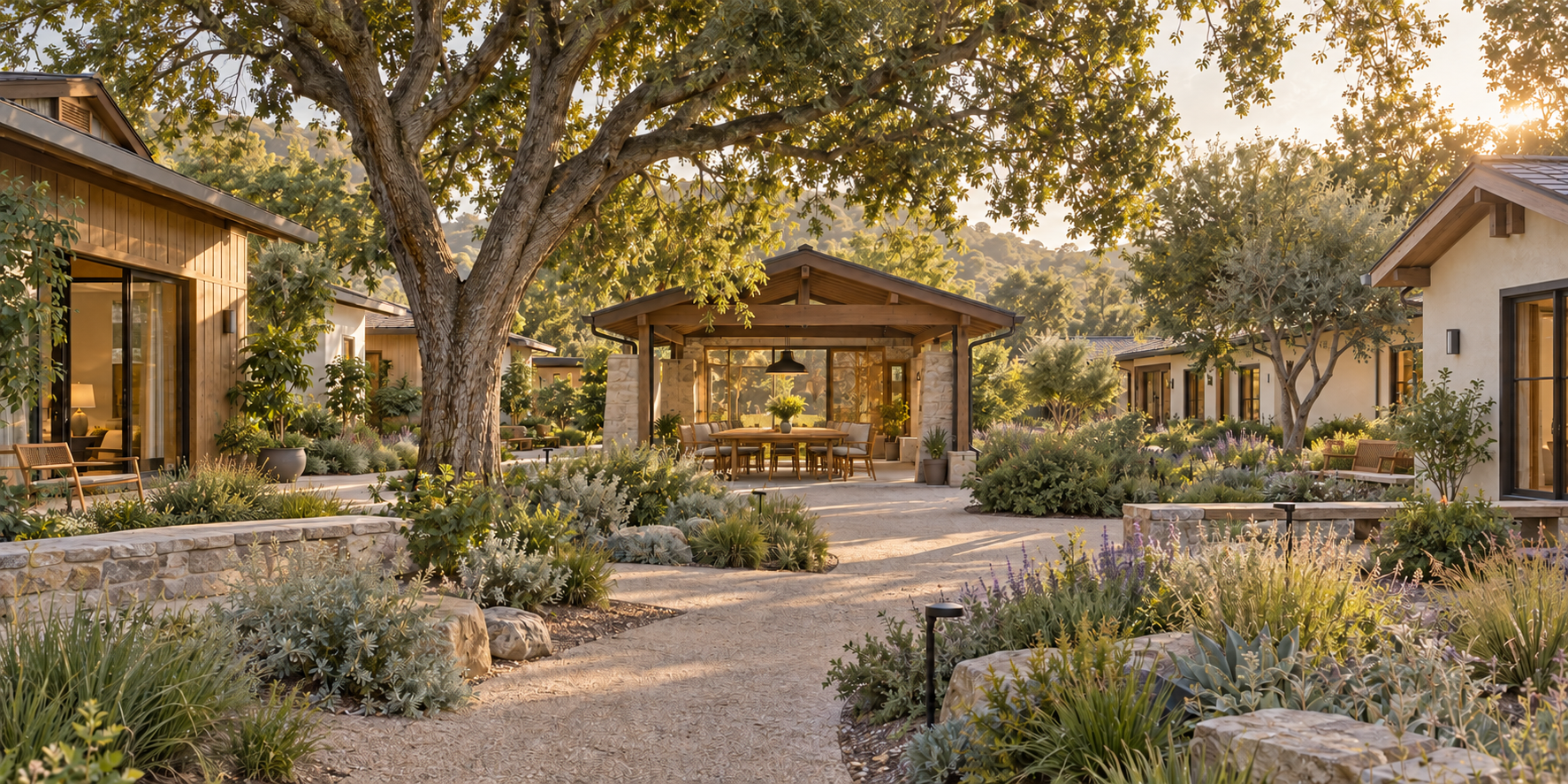
The whole place has to work
A low land price does not establish affordable homes. Water, wastewater, accessible paths, common rooms, insurance and reserves belong in the same budget. Shared ownership also needs a lawful occupancy and admissions model.
The detailed dossiers below retain their housing arguments, source receipts and climate figures. Their earlier rank is historical and under review.
What this earlier comparison sought
A lawful, serviceable first phase for twenty or more men, a realistic expansion path, outdoor life with workable mitigation, full capital and monthly costs, care and transport matched to likely residents, and affirmative evidence of relocation confidence. We will compare those on equal terms before naming a true top candidate. Youth, parent and transgender survey findings cannot automatically stand in for older cisgender gay men; trans men and men with HIV also need their own relevant evidence.
Program limits and source dates matter. Unknown does not mean prohibited, and a proposed rule or failed webpage retrieval does not establish current law.